My Dad Died Ten Years Ago Today

Ten years ago today, my Dad, Dick Chanski got a visit from a swift chariot that swept him quickly to his heavenly home.  He was 71 years old.  We miss him.  But we know that to live is Christ, and to die is gain.

Right now, I’m just outside of Comerica Park in Detroit.  My three sons, Calvin, Austin, Nate, and I have just watched the Tigers play the Twins – in the tradition of my dad taking his sons – Greg, Dave, Mark, and Chris to Tiger games over the years.

One thing different in this generation though – we don’t leave early in order to beat the traffic!  I still remember the time Dad led us out in the top of the ninth because the Tigers were down by a couple.   Outside the stadium, we heard a thunder roar cheer.  We ran back inside the Tiger Stadium centerfield bleachers see Eddie Brinkman touching the plate after a multiple run homer!  Tigers won.  We got an unforgettable Dad story.

Dad was “only a dad, but the best of men”.  He was the best!

He had his sayings:

“Step into my office,” he’d say when he had some priceless advice to give, which was quite often, though he had no office.

“God draws straight with crooked lines,” he’d say referring to God’s causing all things (even tragic things) to work for good.

“Enter, rejoice, and come in,” he’d sing to a visitor to our home, quoting a song he used to sing in the Catholic church.  He’d still whistle the Notre Dame fight song while cleaning up after a Sunday afternoon fellowship dinner at the Reformed Baptist Church of Holland.  And I’d think, “What are we gonna do with that guy?”

“Write down on a piece of paper who you’d rather be,” he said to me when I woke up at age 16 from my ankle surgery to the surgeon’s telling me I couldn’t run for a year, and would have to miss both the basketball and baseball season.

“Hey, John, when’s the baby due?” he said to a young friend who had carelessly put on some unnecessary beer-belly pounds.

“Lady, you can’t get there from here,” he once sweetly said to a woman who had stopped to ask him for directions, but then actually argued and couldn’t seem to grasp what Dad was trying to tell her.

“Hey Superstar,” he’d say to me, just to encouragingly convey that he thought I was something pretty special.

“This is a humbling game,” he’d say when I’d hit a golf ball into the water hazard.

“You can’t do that anymore!  You’re married and have kids now!” he’d say to his older sons who would dive to make a circus softball catch, or slide head first into second base.

“Good job!” he’d say with a nod and a tightened lower lip when we did something worthy of commendation.

Whenever I reach for an apple, I think of which one my dad would choose – the most bruised one.  That’s the kind of a man he was.  He esteemed his loved ones far above himself.  He didn’t matter.  We did.

He spent himself for us.  Whenever any of us needed help or aid or assistance, he’d show up.   Not long before he died, Dianne, my wife, purchased a bedroom set for our daughter Abigail.  Dad showed up with his tools to put the bed together, making sure everything was all set for his Lady Di and Abbie-girl.

Austin, my son, said it best when we all sat around after the funeral a decade ago, reminiscing about Dad and Papa: “He was always there!”

That’s it!  And now we miss Him.  But thanks be to God for the blessing he was and still is.

My Dad was a mighty man of God who held his integrity to the end.  He finished very, very, well.  He is my hero.  I want to be like him.  I want my sons and daughter to think of me someday, as I think of him today.

Calvin is driving.  We’re near Lansing now.  Tigers lost tonight.  But that’s okay.  Dad was there.

Posted in Uncategorized | 1 Comment

Questions in the Baptism Pool – A Good Confession


Baptism Questions

 all properly answered with “Yes, I do!”

1. Do you believe in the one true and living God, who exists in three distinct persons: Father, Son, and Holy Spirit?

2. Do you believe that He made all things out of nothing, and that He always upholds them in such a way that nothing comes to pass apart from His Sovereign will?

3. Do you believe that left to yourself, you are a hell deserving sinner, born in original sin, and guilty of great personal sin?

4. Do you believe that you, as a sinner, are wholly incapable of doing anything good to merit God’s favor, and that you have frequently broken His commandments in thought, word, and deed?

5. Do you believe that Jesus Christ who was born of the virgin Mary, is fully God and fully man, and therefore capable to provide an atoning sacrifice for your sins?

6. Do you by faith trust in and rest alone upon Jesus Christ, and his death, burial, and resurrection for your righteousness and salvation?

7. Do you, with grief and hatred of your sins, turn from them, and to God, with full purpose of and endeavor after, new obedience and a holy life?

8. Do you embrace the Holy Scriptures of the Old and New Testaments as inspired by God, inerrant, and authoritative, and therefore your only rule of faith and practice?

9. Do you take the people of God in the universal church, and in this local church, to be your people, to whom you owe a solemn accountability?

10. Do you resolve to live a life worthy of Christ and constrained by His love, to forsake the world and its lusts, and to seek His “Well done” on the last day?

*On the basis of this good confession, I baptize you in the name of the Father, the Son, and the Holy Spirit.


Posted in Uncategorized | 2 Comments

Spurgeon Recounts His Baptism at Age 15

I can never forget the 3rd of May, 1850 ; it was my mother’s birthday, and I myself was within a few weeks of being sixteen years of age. I was up early, to have a couple of hours for quiet prayer and dedication to God. Then I had some eight miles to walk, to reach the spot where I was to be immersed into the Triune Name according to the sacred command. What a walk it was! What thoughts and prayers thronged my soul during that morning’s journey ! It was by no means a warm day, and therefore all the better for the two or three hours of quiet foot-travel which I enjoyed.

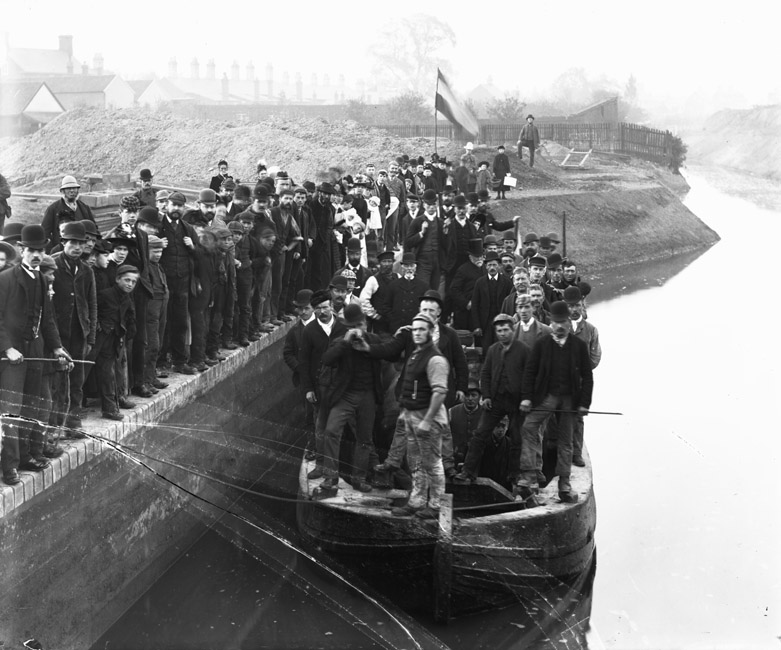
The sight of Mr. Cantlow’s smiling face was a full reward for that country tramp. I think I see the good man now, and the white ashes of the peat-fire by which we stood and talked together about the solemn exercise which lay before us. We went together to the Ferry, for the Isleham friends had not degenerated to indoor immersion in a bath made by the art of man, but used the ampler baptistery of the flowing river. Isleham Ferry, on the River Lark, is a very quiet spot, half-a-mile from the village, and rarely disturbed by traffic at any time of the year. The river itself is a beautiful stream, dividing Cambridgeshire from Suffolk, and is dear to local anglers. The navigation of this little River Lark is possible between Bury St. Edmund’s and the sea at Lynn; but at Isleham it is more in its infancy.

The ferry-house, hidden in the picture (on page 147) by the trees, is freely opened for the convenience of minister and candidates at a baptizing. Where the barge is hauled up for repairs, the preacher takes his stand, when the baptizing is on a week-day, and there are few spectators present. But on Lord’s-day, when great numbers are attracted, the preacher, standing in a barge moored mid-stream, speaks the Word to the crowds on both sides of the river. This can be done the more easily, as the river is not very wide. Where three persons can be seen standing, is the usual place for entering the water. The right depth, with sure footing, may soon be found, and so the delightful service proceeds in the gently-flowing stream. No accident or disorder has ever marred the proceedings. In the course of seven or eight miles, the Lark serves no fewer than five Baptist churches, and they would on no account give up baptizing out of doors.

To me, there seemed to be a great concourse on that week-day. Dressed, I believe, in a jacket, with a boy’s turn-down collar, I attended the service previous tc the ordinance ; but all remembrance of it has gone from me: my thoughts were in the water, sometimes with my Lord in joy, and sometimes with myself in trembling awe at making so public a confession. There were first to be baptized two women, —Diana Wilkinson and Eunice Fuller,—and I was asked to conduct them through the water to the minister; but this I most timidly declined. It was a new experience to me, never having seen a baptism before, and I was afraid of making some mistake.

The wind blew down the river with a cutting blast, as my turn came to wade into the flood; but after I had walked a few steps, and noted the people on the ferry-boat, and in beats, and on either shore, I felt as if Heaven, and earth, and hell, might all gaze upon me; for I was not ashamed, there and then, to own myself a follower of the Lamb. My timidity was washed away; it floated down the river into the sea, and must have been devoured by the fishes, for I have never felt anything of the kind since. Baptism also loosed my tongue, and from that day it has never been quiet. I lost a thousand fears in that River Lark, and found that “in keeping His commandments there is great reward.”

— from Spurgeon’s Autobiography THE EARLY YEARS, Banner of Truth

Posted in Uncategorized | Leave a comment

Why Change the Name of Our Church?

The Reformed Baptist Church has been at 269 Douglas Ave. in Holland since 1997.  Our bold sign with the “Bible-inside-the-Trumpet” logo has decorated the way-to-the-beach for nearly a decade and a half.

But north side drivers have discovered a change.  A new sign has now been erected in the church’s front yard.  It reads: “HARBOR CHURCH” in large print, and then “Reformed & Baptist” in small print.  And instead of a Bible-and-Trumpet logo, there is now a pair of refreshing blue water-waves.

What’s going on?

The church has changed its name — officially to Harbor Reformed Baptist Church.  But the shorthand version has become “Harbor Church”.

But why the change?

“When we started up here in Holland, nearly 18 years ago, the name “Reformed Baptist” meant something to the rank and file of the folks on the Lakeshore.  Many would ask, ‘How can you be both Reformed and Baptist?  Is that possible?’  From there, we could explain that we are Reformed in theology like John Calvin, but that we baptize only born again believers (not infants) like Charles Spurgeon.”

“But the cultural and religious landscape has changed a bit since the early nineties.  Now average folks aren’t as informed about doctrine and history.  The theological terminology doesn’t resonate as much today with the Lakeshore community.  And it’s the community that we desire to reach!  So we’ve crafted a new name that we believe expresses more of an open invitation to our friends and neighbors.”

“A harbor is a haven of refuge from storm tossed seas.  That’s what a faithful church should be to its visitors, attenders and members.  This world seeks to beat up and shipwreck our lives and families.  But our souls can find rest and safety in a biblical, Christ-centered community of believers.  That’s what Harbor Church is all about.”

“And it’s a natural!  From our steeple, you can see the blue waters of the harbor Lake Macatawa.”

“Our beliefs and convictions haven’t changed.  We still ground our ministry on the solid rock of biblical preaching and teaching.  Our faith and practice are still based on the Scriptures.  Men, women, and children must repent of their sins and believe in the Lord Jesus Christ that they might be saved from God’s wrath, and be strengthened by God’s Spirit.”

“With our new sign: HARBOR CHURCH, we open our arms wide to our weary, wet and wind-whipped friends and neighbors, and invite them to come in and find a place of safety and refuge from the storm.”

“We’re saying to our community what Jesus said in Matthew 11:28: ‘Come to Me, all who are weary and heavy-laden and I will give you rest.’”

Posted in Uncategorized | 2 Comments

With All His Might!

The way Austin Jackson plays centerfield for the Tigers (saving Verlander of a run), is the way saints ought to labor hard for the kingdom (saving souls from destruction) — with all our might!

Posted in Uncategorized | Leave a comment

Taking Dominion on Justin Taylor’s Blog Between Two Worlds

http://thegospelcoalition.org/blogs/justintaylor/2011/08/05/taking-dominion/

Guest Post by Robert Sagers

Mark Chanski, author of Manly Dominion and Womanly Dominion and the pastor ofHarbor Reformed Baptist Church of Holland, Mich., was kind to answer a few questions about what it means for men and women to be men and women of (biblical) dominion.

Robert Sagers: What does it mean to be a man of dominion?

Mark Chanski: A man of dominion seeks to boldly subdue and rule over the circumstances of his life, instead of passively permitting the circumstances of his life to subdue and rule over him. He dominates his environment instead of letting his environment dominate him.

The cornerstone passage is the Dominion Mandate found in Genesis 1:28, the Lord’s first recorded words to his image bearing creatures: “Be fruitful and multiply, and fill the earth, and subdue it; and rule over the fish of the sea and over the birds of the sky, and over everything living that moves on the earth.”

God had just taken the chaos of a formless and void world, and in the space of six days, fashioned it into an orderly and “very good” creation. An image bearing man of dominion imitates his God. He subdues (brings into bondage, makes to serve him by force) and rules(governs, reigns, and holds sway over) the spheres (earth, sea, sky) around him. A man of dominion is boldly active.

In contrast, a billiard ball is timidly passive. It allows itself to be acted upon and pushed around by cue sticks, fellow balls, and bumpers. Not so the billiard player. He assertively imposes his plans on the table configuration by the forceful thrusts of his cue stick. He subdues and rules.

On the table of life, many men today function more like passive billiard balls than like active billiard players. This is seen in family life where many men act like couch potatoes failing to husband, father, and rule; in vocational life where many are sluggards failing to plan ahead, labor, and drive to excellence; in church life where many are AWOL: failing to lead, direct, and serve; and in personal life where many are weaklings failing to exercise self control, kill sins, and manage priorities.

Whenever God speaks and assigns, the serpent slithers and whispers, “Yea, has God said?” And so, many of us believe his lies, and adopt a posture of helpless victimization instead of bold dominion. One says, “I’m a genetic victim with bad DNA, and that’s why I’m obese, an alcoholic, or tranquilizer dependent. I can’t subdue and rule.” Another says, “I’m an emotional victim who’s been badly treated by significant others, and that’s why I can’t hold a job, control my sexual life, or stay off of drugs.” Still another, “I’m a circumstantial victim whose boss, wife, or government makes it impossible for me to succeed.” So instead of exercising dominion, we give excuses.

When faced with a daunting challenge (i.e., losing weight, disciplining our children, organizing our day), our motto should be: “I can, and so help me God, I will!” But at many times it becomes: “I probably can’t, so I won’t even try!” I confess my own struggles here.

But the Bible is full of men who were given daunting assignments, and found a way get them done. Noah built a freighter-sized ark in the face of a laughing world, with a 500 year-old body, in a pre-Home Depot era. Joseph overcame abusive brothers, a seductive temptress, and depression-provoking disappointments to become the prime minister of Egypt. Nehemiah fought through backbreaking rubble piles and sinister enemy conspiracies to finish the Jerusalem wall in 52 days. Paul endured brotherly rejection, Jewish persecution, and Roman incarceration to finish his missionary race.

The mightiest of all men of dominion is Jesus Christ Himself. Though he had poor parents, was called illegitimate, was ridiculed, entrapped, betrayed, scourged, and even crucified, he stayed at his post until he was able to shout regarding his epic errand, “It is finished.” Hallelujah, what a Savior!

A man of dominion seeks to imitate his Lord and Savior in every life assignment, whether it’s in school, at work, in marriage, in parenting, in churchmanship, or in personal godliness. So help him God, with no excuses, he seeks to subdue and rule in every sphere to the glory of his Maker and Redeemer.

RES: What does it mean to be a woman of dominion?

MC: Women have received the same dominion mandate as men. “And God created man in His own image, in the image of God He created him; male and female He created them. And God blessed them; and God said to them, ‘Be fruitful, multiply and fill the earth, and subdue it; and rule . . .’” (Genesis 1:27-28).

So women too need to fight off a sinful propensity toward timid passivity, and put on a dominion mindset of bold activity. Women are faced with daily life challenges just as daunting as men’s:

—Shall I apply for acceptance in the university’s highly competitive nursing program, or passively concede failure without even trying?
—Shall I surrender under the crushing pressure of term papers and final exams, or find a way, so help me God, to study my way through, and pass these classes?
—Shall I get romantically involved with a man of poor character because I’m afraid of becoming a spinster, or shall I faithfully stay the course and wait for a true man of God?
—Shall I permit my family’s home to fall into chaotic disarray, or resolve to labor diligently to maintain an orderly household?
—Shall I passively watch my children be swallowed up into the vortex of a godless culture, or valiantly fight the good fight to raise them in the fear of the Lord?

Godly women, made in the image of God, must daily tell themselves to subdue and rule, to the glory of God.

But women, unlike men, are faced with an additional fierce life challenge. They’ve also got to “play their position.” Coaching our daughter’s soccer teams found me constantly shouting to my players, “Play your position!” If I have a goalie who’s not convinced of the importance of guarding the goal, but is convinced that the only important contribution is scoring goals, that roaming and undisciplined player will do great harm to the team. Imagine the damage done when a girl assigned to play goalie leaves her post to make a long and exciting dribble run up the field, only to be stripped by an opponent who’s able to dribble back and to score into a goalie-less net! I’d shout, “Jessica, you’re a goalie, not a forward. Play your position! Everybody’s counting on you! Play your position!”

On the field of life, women not only have to play boldly, but they’ve also got to play their position. God hasn’t positioned women in such “forward” positions as Family Leader, Breadwinner, and Pastor. Eve was positioned by her heavenly coach as a “helper suitable” (Genesis 2:18), a child nurturer (Genesis 2:16), and a submissive learner (1 Timothy 2:11-15). But women hear shouts from unprincipled sideline voices telling them to leave their God-assigned posts, much like a misguided parent might tell his goalie daughter: “Get the ball, honey, and try to score!”

—The army recruiter at the high school tells her that women are well suited for military combat.
—Her college professor insists that she should pursue a Ph.D. and not let her pursuit be derailed by the patriarchal institution of marriage and childbearing.
—Her magazines tell her that her husband has no right to expect her to abandon her career to stay home with the children, while he continues to climb the corporate ladder.
—Her own inner voice tells her that selflessly serving her husband and her children is a thankless waste of a life.
—And her neighbor friend tells her that her spiritual maturity merits her being recognized as an elder in her church.

Godly women, made in the image of God, must daily tell themselves: “Play your position! Stay at your assigned post, to the glory of God.”

So a woman of dominion must have “a gentle and a quiet spirit” (1 Peter 3:4), as she must play her position. But that’s not the whole story. She must also boldly subdue and rule in her challenging assignments.

The Bible is full of bold women. Zelophehad’s daughters boldly brought their grievance to Moses and won their case, and God’s commendation (Numbers 27:1-7). Deborah “quit herself like a man” when passive billiard ball Barak refused to do his duty (Judges 4). Abigail saved her family by virtuously outmaneuvering Nabal and deftly advising David, to the admiring delight of the latter (1 Samuel 25). The lady of Proverbs 31 is a lovely subduer and ruler par excellence. Priscilla, whose name precedes her husband Aquila’s, helped teach the great Apollos the way of God more accurately (Acts 18:24-28). And Phoebe is saluted as a strategic and influential helper of the church at Cenchrea (Romans 16:1-2).

Such female heroes rightly brighten the eyes of Christian women!

So a woman of dominion is more than a gentle and quiet spirit. She boldly subdues andrules in her God-appointed positions to the glory of God.

RES: How can the church best equip its members to be men and women of (biblical) dominion?

MC: First, by being unapologetically countercultural in our teaching of the Scriptures. Our people are daily the targets of high octane media propaganda that promotes relativism, liberalism, feminism, and excuse-ism. The faithful declaring of the whole counsel of God should perceptively expose the subtle lies of the journalist, therapist, panelist, novelist, artist, feminist, etc.

Second, by modeling biblical manhood in church life. For example, men should:

—make their families’ consistent attendance a principled priority, not a feeling-driven option.
—step up to the plate in Sunday School classes and prayer meetings in such a manner that their verbal contributions lead the way, and not leave a void, provoking the women to take over.
—engage in spiritually-minded conversations that spur each other on to love and good works.
—go home, and throughout the week lead their families in consistent family devotions.
—work hard and with excellence at their vocations, enabling them to support both their own families and kingdom endeavors.

Third, by modeling biblical womanhood in church life. For example, women should:

—relish their God-honoring roles as submissive learners and followers.
—take up their strategic opportunities as strategic teachers. The church is teeming with needy women and children, and a wise Apollos will hear a discreet Priscilla.
—extend hospitality in its countless forms. A Christlike, foot-washing, servant-hearted woman is a mighty kingdom weapon. Think of Edith Schaeffer at L’Abri. Women are the church’s infantry.
—go home, and boldly mother their own children. The hand that rocks the cradle is the hand that rules the world.
—commit themselves to being passionately dedicated helpmeets to their own husbands.

Fourth, by praying with dependence on the Spirit. We can’t subdue and rule over anything apart from our Savior’s power. Apart from him, we can do nothing (John 15:5).


Posted in Uncategorized | Leave a comment

A Friend’s Bride Dying after 8 Years of Cancer

On Monday, my friend Gordon wrote:

While Laura struggles to breathe I lay next to her helpless, washed up on the beach, each wave a memory of the bride of my youth.

Inside her withered shell lies the beautiful doe I first saw at the waters edge 18 years ago. I can still remember the moment our eyes met. Hers were bright, eager, welcoming and happy.

Through cancer they have been replaced by dark, dim mirrors of sadness, fear and pain.

My heart breaks for my bride. I miss her so. I did not know how much I loved her until now.

God surely knitted us together in that garden 13 years ago. Removing a strand from three is not easily done. Like vines we have surely grown into one.

The waves are pounding, deafening, relentless. I must get up before they break my back.

I’m going for a run. While running I will breathe less hard than she does sleeping. She is running in her sleep. Running to the gates. I’m cheering her on. I will miss her dearly but want her to cross the line this day, this hour, this minute. I want her to be freed from this withered shell. Free to float easily in Gods glory. Free of the burden of pain. Free of all shame. I want her to be free. She deserves to be free. Dear merciful God bring her home…soon.

Very early Wednesday morning, Laura was set free.

“For me to live is Christ, and to die is gain” (Philippians 1:21).

“A dying man is a balloon throwing down its ballast.” (Petit Senn)

Hallelujah, what a Savior!

Posted in Uncategorized | Leave a comment

The Fear of God – A Protecting Safeguard

“And if you address as Father the One who impartially judges according to each man’s work, conduct yourselves in fear during the time of your stay upon the earth” (1 Peter 1:17).

Thomas Watson says:

“Labor to get the fear of God into your hearts.  As a levee embankment keeps out the flood waters, so the fear of the Lord keeps out moral uncleanness.  Those who lack the fear of God, lack a bridle that should check them from sin.  Bernard calls holy fear,  janitor animae, the door-keeper of the soul.  As a nobleman’s porter stands at the door, and keeps out vagrants, so the fear of God stands and keeps sinful temptations from entering.”

(Thomas Watson, The Ten Commandments,  p 161)


Posted in Uncategorized | 1 Comment

Is Church Membership Biblical? by Matt Chandler

“The spouse of Christ cannot be adulterous; she is uncorrupted and pure. She knows one home; she guards with chaste modesty the sanctity of one couch. She keeps us for God. She appoints the sons whom she has born for the kingdom. Whoever is separated from the Church and is joined to an adulteress, is separated from the promises of the Church; nor can he who forsakes the Church of Christ attain to the rewards of Christ. He is a stranger; he is profane; he is an enemy. He can no longer have God for his Father, who has not the Church for his mother.”

— CyprianTreatise on the Unity of the Church, 6.

Some Background

I was 28 when I became the pastor of Highland Village First Baptist Church (now known as The Village Church). I had had a rough go early on in my church experience, and at that time I was not fully out of my “disenchanted with the local church” phase.

In all honesty, I wasn’t sure at the time that church membership was biblical. Despite that, the Spirit had made it all too clear that I was going to be pastoring this small church in the suburbs of Dallas. That was one of the many ironies of my life in those days.

Highland Village First Baptist Church was a “seeker-sensitive” church in the Willow Creek mold and had no formal membership process, although they were actively working on one and wanted the new pastor’s input. I had a strong understanding of the church universal but wasn’t well versed—and, as I said, somewhat skeptical—about the church local. We started growing quickly with young and oftentimes disenchanted 20-somethings who usually had no church background, or bad church backgrounds. They liked The Village because we were “different.” This always struck me as strange because we weren’t doing anything but preaching and singing.

If there is no understanding of local church membership, then who are we to submit to and obey

In conversations with these men and women I began to hear things like “The church is corrupt; it’s just about money and a pastor’s ego,” or “I love Jesus, it’s the church I have a problem with.” My favorite one was, “When you organize the church it loses its power.” Although something occasionally resonated in me with these comments (I, along with most of my generation, have authority and commitment issues), I found them confusing since they were being made to me by people who were attending the church where I was the pastor.

Two Questions from Hebrews 13:17

With conflicts already brewing over other doctrines that I viewed as far more central, I wondered if we should let this church membership thing slide and come back to it later. I was preparing at the time to preach through the book of Hebrews and “happened” to be in chapter 13 when verse 17 leapt off the page: “Obey your leaders and submit to them, for they are keeping watch over your souls, as those who will have to give an account. Let them do this with joy and not with groaning, for that would be of no advantage to you.”

Two questions occurred to me:

  • First, if there is no biblical requirement to belong a local church, then which leaders should an individual Christian obey and submit to?
  • Second, and more personally, who will I as a pastor give an account for?

These two questions started my search for a biblical understanding of the local church, and they began around the ideas of authority and submission.

Regarding the first question, the Scriptures clearly command Christians to submit to and honor an elder body (Heb. 13:171 Tim. 5:17). If there is no understanding of local church membership, then who are we to submit to and obey? Is it anyone with the title “elder” from any church? Should you as a Christian obey and submit to those loons at Westboro Baptist? In order to obey Scripture, must you picket soldiers’ funerals, as the pastor of Westboro seems to imply?

Regarding the second question, the Scriptures clearly command an elder body to care for specific people (1 Pet. 5:1-5; also, Acts 20:29-30). Will I as a pastor be held accountable for all the Christians in the Dallas Metroplex? There are many churches in Dallas that I have strong theological and philosophical differences with. Will I give account for what they teach in their small group, how they spend their money, and what they do concerning international missions?

What about Church Discipline?

After considering questions of authority and submission, the second issue that came up in my study of the local church was the biblical teaching on church discipline.

You see it in several places, but none so clearly as 1 Corinthians 5:1-12. In this text Paul confronts the church in Corinth for approving of a man walking in blatant, unrepentant sexual immorality. The Corinthians are celebrating this as God’s grace, but Paul warns them that this type of wickedness shouldn’t make them boast, but rather mourn. He calls them arrogant and tells them to remove this man for the destruction of his flesh and the hopeful salvation of his soul. In verses 11-12, he pulls no punches: “But now I am writing to you not to associate with anyone who bears the name of brother if he is guilty of sexual immorality or greed, or is an idolater, reviler, drunkard, or swindler—not even to eat with such a one. For what have I to do with judging outsiders? Is it not those inside the church whom you are to judge?”

Church discipline won’t work if local church membership doesn’t exist.

It has been my sad experience that very few churches still practice church discipline, but that’s another article for another day. My question out of this text is simple: How can you kick someone “out” if there isn’t an “in”? If there is no local commitment to a covenant community of faith, then how do you remove someone from that community of faith? Church discipline won’t work if local church membership doesn’t exist.

Lots of Other Evidence for Membership

There are other evidences to support local church membership in the Scriptures.

  • In Acts 2:37-47, we see that there is a numerical record of those who have professed Christ and been filled with the Holy Spirit (v. 41) and an acknowledgement that the church was tracking the growth (v. 47).
  • In Acts 6:1-6, we see elections take place in order to address a specific problem and accusation.
  • In Romans 16:1-16, we see what appears to be an awareness of who is a church member.

In 1 Timothy 5:3-16, we see a clear teaching on how to handle widows in the church and in verses 9-13 we read this:

    Let a widow be enrolled if she is not less than sixty years of age, having been the wife of one husband, and having a reputation for good works: if she has brought up children, has shown hospitality, has washed the feet of the saints, has cared for the afflicted, and has devoted herself to every good work. But refuse to enroll younger widows, for when their passions draw them away from Christ, they desire to marry and so incur condemnation for having abandoned their former faith. Besides that, they learn to be idlers, going about from house to house, and not only idlers, but also gossips and busybodies, saying what they should not.

In this text we see criteria for who would or would not qualify for Ephesus’s widow care program. The local church in Ephesus is organized, and they are working out a plan.

We could go on and on here, asking questions about how we could be obedient to the commands of God in 1 Corinthians 12 orRomans 12 if we aren’t connected to a local covenant community of faith. But to unpack all the possible texts would require longer than I have for this article.

When church is just a place you attend without ever joining, like an ecclesiological buffet, you just might consider whether you’re always leaving whenever your heart begins to be exposed by the Spirit, and the real work is beginning to happen.

God’s Plan is That We Would Belong to Local Churches

When you begin to look at these texts it becomes clear that God’s plan for his church is that we would belong to a local covenant community of faith. This is for our own protection and maturation, and for the good of others.

If you view church as some sort of ecclesiological buffet, then you severely limit the likelihood of your growing into maturity. Growth into godliness can hurt. For instance, as I interact with others in my own local body, my own slothfulness in zeal is exposed, as is my lack of patience, my prayerlessness, and my hesitancy to associate with the lowly (Rom. 12:11-16). Yet this interaction also gives me the opportunity to be lovingly confronted by brothers and sisters who are in the trenches with me, as well as a safe place to confess and repent.  But when church is just a place you attend without ever joining, like an ecclesiological buffet, you just might consider whether you’re always leaving whenever your heart begins to be exposed by the Spirit, and the real work is beginning to happen.

What’s the bottom line? Local church membership is a question of biblical obedience, not personal preference.

Article originally posted on 9 Marks

© 9Marks. Website: www.9Marks.org. Email:info@9marks.org. Toll Free: (888) 543-1030.

Posted in Uncategorized | Leave a comment

Our New Church Sign in Holland, Michigan

Here is the new sign for Harbor Reformed Baptist Church. Our hope is that it extends friendly arms of invitation to storm tossed and weary voyagers who need refuge in our Savior.

Posted in Uncategorized | Leave a comment