Was Adam Lanza The Newtown Shooter Merely Sick?

Man In Psychologist's Office With Money Rug

We cannot accept the inevitable claims that this young murderer is to be understood as merely sick.

Dr. Albert Mohler continues in his insightful blog:

His heinous acts will be dismissed and minimized by some as the result of psychiatric or psychological causation, or mitigated by cultural, economic, political, or emotional factors. His crimes were sick beyond words, and he was undoubtedly unbalanced, but he pulled off a cold, calculated, and premeditated crime, monstrous in its design and accomplishment.

Christians know that this is the result of sin and the horrifying effects of The Fall. Every answer for this evil must affirm the reality and power of sin. The sinfulness of sin is never more clearly revealed than when we look into the heart of a crime like this and see the hatred toward God that precedes the murderous hatred he poured out on his little victims.

This Christmas season reminds that in the first century King Herod decreed that all baby boys under two years should be killed in Bethlehem.

The twentieth century forced us to see the ovens of the Nazi death camps, the killing fields of Cambodia, the inhumanity of the Soviet gulags, and the failure of the world to stop such atrocities before they happened. We cannot talk of our times without reference to Adolf Hitler and Josef Stalin, Pol Pot and Charles Manson, Idi Amin and Ted Bundy. More recently, we see evil in the impassive faces of Osama bin Laden and Anders Behring Brevik. We will now add yet another name to the roll call of mass murderers.

Read Al Mohler’s entire blog post here:

http://www.albertmohler.com/2012/12/14/rachel-weeping-for-her-children-the-massacre-in-connecticut/

In his radio broadcast on this theme, Dr. Mohler added:

In the aftermath of all of this, many questions will be asked.  Many theories will be propounded.  Many observations and commentaries will be offered.  One of the things we’re almost certain to hear is that some psychological imbalance, some psychosis is the cause of this, that some addiction or some narcotic or drug interaction caused this.  Some lack of one thing, or abundance of another thing was the cause of this. 

The reality is that we who are Christians have to keep our mind on the fact that though these things may be part of the circumstance, they may be part of the equation, the indispensable reality is that a human being of his own volition, knowingly in a premeditated fashion planned and accomplished this murder.  

And thus, even as we may be concerned about what we would learn about psychological or psychiatric or pharmacological or any other form of influence in this:  At the end of the day we have to recognize that Christians have no biblical option but to call this thing what it is — sin, evil, murder, death. 

To this, we can add regarding the identification of sin as sin:

Jeremiah 17:9: “The heart is more deceitful than all else and is desperately sick; who can understand it?”

Mark 7:20-23: “And He was saying, “That which proceeds out of the man, that is what defiles the man. For from within, out of the heart of men, proceed the evil thoughts, fornications, thefts, murders, adulteries, deeds of coveting and wickedness, as well as deceit, sensuality, envy, slander, pride and foolishness. All these evil things proceed from within and defile the man.”

There is a cure for this evil of sin.  Thanks be to God through Jesus Christ our Lord!

Posted in Uncategorized | 2 Comments

Should Christians Fast Today?

prayer-and-fast24

Donald Whitney writes on the Discipline of Fasting:

How often do you think fasting is mentioned in the Bible? By my count, there are so me seventy-seven biblical references to fasting. Do es that surprise you? Despite so many references, fasting is not a frequent subject in pulpits, publications, and Christian conversation.

In part, this may be due to the fact that, while fasting may be done cooperatively with fellow believers (as in Acts 13:2), typically it is private in nature and shouldn’t be evident to others (Matt. 6:16–18). So it’s possible that Christians around us fast more than we realize or hear mentioned. But could the main reason that fasting is seldom taught be that fasting is seldom practiced?

Should Christians Fast Today?
As a result of the famine of teaching on the subject, there are a number of common misunderstandings among believers about the discipline of fasting. One is the idea that it is a practice relegated only to biblical times or to religious eccentrics. But Jesus, when asked why His disciples never fasted, replied, “The days will come when the bridegroom is taken away from them, and then they will fast” (Matt. 9:15). Until the ascended Bridegroom returns for His bride, fasting is a spiritual discipline His disciples will occasionally practice. This was the understanding of Christians in the book of Acts, who are reported fasting in 13:2 and 14:23. And church history reports that since the days of the New Testament, the followers of Jesus have likewise engaged in fasting.

Fasting and the Gospel
Another misconception about fasting occurs when people fail to associate it with the gospel. The most egregious version of this is the belief that fasting can impress God enough that He will open the door of heaven for those who deny themselves in this way. That, of course, implies that the life and death of Jesus are unnecessary (“Why repent and trust in Jesus? Just fast a little and heaven is yours.”), which is the greatest possible insult to the Father. Neither fasting nor anything else we could do — no matter how painful, self-sacrificial, or unselfish — can atone for our sins and reconcile us to God. Only Jesus, who offered Himself as a sinless sacrifice to bring others to God, can do that.

But it is also possible for genuine Christians to fast but fail to associate their fast with the gospel. They may fast simply in an effort to get things from God. In the New Testament, however, fasting is related to the spread of the gospel or the fruit of the gospel. Similarly, New Testament believers today should fast in a way connected with the spread of the message of Jesus or fast as those who are the servants of Jesus.

So a Christian might fast, for example, and connect it with prayer for missionary labors, for the Sunday morning sermon, or for his witness to a friend. He might fast with prayer primarily for a personal concern, but rest his confidence that God will answer, not on the basis of his abstention from food, but on the fact that he fasted and prayed in the name of Jesus.

So the error on one side is failing to fast at all, and on the other, fasting with confidence in the work of fasting rather than in the work of Christ.

Fasting for a Biblical Purpose
From the pragmatic perspective, the most common oversight is to fast without a clear biblical purpose. When you become aware of your hunger while fasting, you often remember, “Oh yeah, I’m hungry because I’m fasting.” Your next thought should be something like this: “And I’m fasting for this purpose.” There are at least ten purposes in Scripture for fasting, and most relate to prayer. So your hunger actually serves you during a fast in that it is a constant reminder about your biblical purpose, in this case to pray.

Fasting has to be a discipline, otherwise it is a blessing we’ll never experience. When should you fast? Times of special need, when important decisions must be made, or occasions when spiritual longings are especially intense, are often promptings to enter into a fast. But Christians are free to experience the blessings of fasting as often as they desire. Fasting expresses in a God-ordained way our belief that we have tasted and seen that the Lord is good (Ps. 34:8) — so good that there are times we’re satisfied to feast on Him instead of the food that the Lord made for us to live on. Fasting is a temporary physical demonstration that we believe the truth declared by the gospel, namely that, “Man shall not live by bread alone, but by every word that comes from the mouth of God” (Matt. 4:4). Do you believe that? Do you fast?

From Ligonier Ministries:

http://www.ligonier.org/learn/articles/the-discipline-of-fasting/

See also Spiritual Disciplines for the Christian Life by Don Whitney, (NavPress), p151f.

Posted in Uncategorized | Leave a comment

Backsliding and its Contagious Effects in the Church

stumbling others

At Men’s Breakfast this morning, we discussed how personal backsliding never just stays personal, in a private compartment.  It always spreads and affects others.  Joel Beeke writes:

“Backsliding can advance so far that brother love, one of the most basic marks of saving grace (1 John 3:14), seems to all but disappear within you.  You disagree over nominal matters with fellow believers, unwilling to set down your preferences for their sakes, and those disagreements grow into large fights.  James 4:1 says, ‘What is the source of quarrels and conflicts among you?  Is it not the source your pleasures that wage war in your members?’  Worldliness in church members foments wars within the church.  Plumer said, ‘As piety thus dies in the soul, charity diminishes, and censoriousness takes its place.’

Your own self promotion and self protection can smother any thought of self-sacrifice or service to others.  As this takes place collectively, God’s people become strangers to one another instead of fellow pilgrims.  Conflicts, troubles, disputes, and selfishness multiply.  Ebenezer Erskine said, ‘Backsliders are commonly backbiters.’  Of course, you convince yourself that the conflict is over truth, or some matter of consequence, but deep in your conscience you know it is really only a thinly disguised personality conflict or ‘turf war.’  Otherwise, how did you get along so well before?  Instead of covering one another’s faults, you now gladly take opportunities to talk against one another and defend yourselves.

People of God, can’t we all say we all say with shame that we run more against one another than with one another, as John ran with Peter?  Isn’t there more suspecting, mistrusting, and despising of others than love?  Who among us knows how to forgive, to forebear, to suffer long, and even to suffer wrong at the hands of our brethren?  Christ declared that ‘to whom little is forgiven, the same loves little’ (Luke 7:47).  Do we so undervalue the worth of our salvation (2 Peter 1:9)?

Getting Back in the Race, The Cure for Backsliding (Cruciform Press), p 32-33.


Posted in Uncategorized | Leave a comment

2 & Half Men Star Condemns Own Show as Filth

Chicago Tribune:

Actor Angus T. Jones, star of CBS’s raunchy television comedy “Two and a Half Men”, has urged viewers to change the channel, saying his new-found religious beliefs are at odds with his job playing a fun-loving teen on the popular show.

Jones, 19, who has played Jake Harper – the son of Jon Cryer’s character Alan – for nine years, appealed to fans to stop watching the show “and filling your head with filth.” . . .

According to The Hollywood Reporter, Jones is not scheduled to appear in the final two episodes of the show to be shot before the CBS comedy takes a hiatus for the holidays.

In a YouTube video made for the California-based Forerunner Christian Church, Jones said his recent Bible studies made him uncomfortable with the risque humor that marks one of the most-watched comedies on U.S. television.

“If you watch ‘Two and a Half Men’, please stop watching ‘Two and a Half Men,” Jones says in the video. “I’m on ‘Two and a Half Men’ and I don’t want to be on it.”

“If I am doing any harm, I don’t want to be here. I don’t want to be contributing to the enemy’s plan… You cannot be a true God-fearing person and be on a television show like that.

“I’m not okay with what I’m learning, what the Bible says and being on that television show,” Jones added. . . .

His remarks could pose new problems for the comedy, which was revamped in 2011 following the firing of star Charlie Sheen for erratic behavior off screen and his vicious public dispute with the show’s producers.

Sheen’s womanizing bachelor character and alter-ego, Charlie Harper, was killed off and replaced by Ashton Kutcher, playing an Internet billionaire.

You can read the entire 11/27 Chicago Tribune article here:

http://www.chicagotribune.com/entertainment/chi-angus-t-jones-20121127,0,870446.story

Posted in Uncategorized | 1 Comment

“Would Jesus Spank a Child?” John Piper Responds

A Brief Video:

“Whoever spares the rod hates his son, but he who loves him is diligent to discipline him” (Proverbs 13:24).

Posted in Uncategorized | Leave a comment

That Didn’t Go the Way I Wanted

Joni Eareckson Tada:

They got up, drove him out of the town, and took him to the brow of the hill on which the town was built, in order to throw him down the cliff. (Luke 4:29)

When I return from a ministry trip, I’m often asked, “How’d it go?” Praying friends want to hear about the lives that were changed, as well as how my flight went. A writer named Steven James once pondered how the Lord would have replied: “If Jesus had returned to Capernaum from an afternoon of preaching and had one of the disciples asked him ‘How’d it go?’ he probably would have paused and answered, ‘Let’s see, most of the people didn’t understand what I was talking about, and the ones who did called me demon-possessed and a drunk. Half of the people walked out in the middle of my sermon and then a bunch of folks picked up some rocks and tried to drive me out of town. Other than all of that, I’d say it went pretty well.'”

Working in the kingdom has its ups and downs. Things do not often go the way we want, or even pray. Perhaps you serve on a deacons’ board or a church outreach committee – if plans are going well, volunteers are signing up, and people are responding to Christ’s invitation, be thankful. But if everything is falling apart, if helpers are few and pagans are throwing tomatoes, be faithful. The Father blessed Jesus’ ministry, yet consider all the opposition he experienced, the doors he could barely crack open, and the people who signed up in the beginning, then found better things to do. If the Father is in it, the effort will be blessed.

If in your ministry someone asks today, “How’s it going?” and you’re tempted to give a long litany of all that’s gone askew and haywire, don’t. Remember Jesus. If you are faithful to that which He’s called you, it’s going pretty well!

Lord God, may I remain faithful to that which you’ve called me, no matter what the opposition!

http://www.joniandfriends.org/daily-devotional/

Posted in Uncategorized | Leave a comment

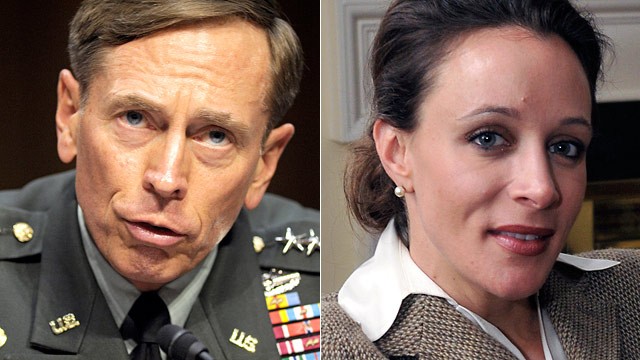
David Petraeus and His Bathsheba

Dr. Albert Mohler yesterday in The Briefing:

Adultery Still Matters: The Downfall of a General

Even in our morally confused age, adultery still matters. Gen. David Petraeus, who until Friday served as Director of the Central Intelligence Agency, had to resign when he admitted to a sexual affair with the woman who had written his biography. That biography is now significantly altered.

Gen. Petraeus was a four-star Army general, known simply as P4 to many insiders. His appointment to the directorship of the Central Intelligence Agency came after he retired from one of the most illustrious careers in the modern American military.

As The New York Times reported:

“He was the preeminent military officer of his generation, a soldier-scholar blazing with ambition and intellect, completing his meteoric rise as a commander in the Iraq and Afghanistan wars. Worshipful Congressional committees lauded him as a miracle worker for helping turn around the war in Iraq, applying a counterinsurgency strategy he had helped devise and that was widely viewed for a time as the future of warfare. Then, dispatched to Afghanistan to replace Gen. Stanley A. McChrystal, who had been fired by President Obama, he sought to apply the doctrine he had championed, while also applying an aggressive counterterrorism strategy. He was fiercely competitive and carefully protective of his reputation.”

Furthermore, the paper noted that “Mr. Petraeus had seemed all but indestructible.” All that came to an end on Friday, when his resignation was announced. In a letter to CIA employees, Petraeus stated the matter directly:

“After being married for over 37 years, I showed extremely poor judgment by engaging in an extramarital affair. Such behavior is unacceptable, both as a husband and as the leader of an organization such as ours. This afternoon, the President graciously accepted my resignation.”

In the past several years, adultery has brought down two governors (Eliot Spitzer of New York, who resigned, and Mark Sanford of South Carolina, who did not), one presidential candidate (John Edwards), and numerous business leaders (including Harry Stoneciper, former CEO of Boeing). The same day that Petraeus’s resignation hit the papers, word came of the fact that the incoming CEO of Lockheed Martin, Christopher E. Kubasik, had been forced out under similar circumstances.

As The New York Times noted, none were more shocked about Gen. Petraeus’ downfall than his former colleagues in the military, who compared his fall to that of David and Bathsheba in the Old Testament.

Christians know that adultery is not merely a sin — it is the breaking of a covenant and a maligning of God’s good gift in marriage. This particular sin also comes with devastating consequences to individuals, families, and institutions. Beyond that, it leads to the unraveling of community.

Even in our day of moral confusion and uncertainty, adultery has consequences. Tellingly, some argued that Petraeus had not done anything worthy of resignation unless national security had been breached. Gen. Petraeus knew better than that, as do we.

http://www.albertmohler.com/2012/11/12/the-briefing-11-12-12/

Posted in Uncategorized | Leave a comment

A Dad Building a Man from a Boy, and a Mom Letting Him Do It

Crawford Loritts:

When I was twelve years old, I experienced a “defining moment.”  Don’t get me wrong; it wasn’t some uncommon extraordinary experience.  It wasn’t a brush with death.  I hadn’t contracted some debilitating disease.  Neither had I been traumatized by some predator.  It was what my father did and what my mother stopped doing that marked me deeply for the rest of my life.  And it happened in less than five minutes.

It all had to do with painting.  The family who rented a property my parents owned moved out, and there was some “fixing up” and painting that needed to be done before the new tenets moved in.  My father thought this would be a great project for the entire family to tackle, so on a Saturday morning, my dad, my mother, my two older sisters, and yours truly reported for duty.  Mom and my sisters were working on the first floor, and my job was to help Pop paint on the second floor.  And that was the problem.  I never did like to paint.  I didn’t then, and I don’t now.So I had to somehow figure out a way to be free of what I thought was an unnecessary burden.

My “ace in the hole” was my mother.  Mom was always more sympathetic to her precious little boy than Dad was, and I knew that if I pressed the right buttons, she would rescue her one and only son from spending his Saturday doing something he didn’t want to do.  So under the guise of having to use the bathroom, I went downstairs and began to complain to Mom.

While I was in the middle of convincing my mother that I needed to take off and play with my friends, Pop showed up.  As I write these words, I am vividly remembering and reliving that momen.My mother said to my father, “Crawford is only twelve years old, and he doesn’t need to be here with us all day.  He needs to be enjoying himself with his friends.”

Then my father said, “Sylvia, I got this.  That boy one day is going to be somebody’s husband and somebody’s father.  There are going to be people depending on him.  He has got to learn how to do what he has to do and not what he wants to do.” To my mother’s credit, she looked at me and then at my father, nodded in agreement, and turned away.  Pop then turned to me and said, “You take yourself upstairs and paint until I tell you to stop.”

And I did.

Even at twelve years old, I knew that something important had just happened.  It wasn’t that I had just lost a little skirmish, and this time I wasn’t going to get my way.  The words “somebody’s husband . . . somebody’s father” and “He has got to learn how to do what he hasto do and not what he wants to do” kept replaying in my mind.  Of course I wasn’t fully aware of the weight of what had happened.  In fact, it would be years before I fully appreciated the significance of that Saturday morning.  But I did have the sense that what just happened was a gamed changer.

My mother knew that in order for her boy to become a man, the most important man in his life needed to shape him.  Pop knew that in order for his son to provide leadership and stability to those who would count on him one day, “Crawford” needed to embrace core lessons in manhood, obligation, and responsibility.

A transition took place that day, and I’m so glad it did.  In a very real sense, it was what some would call a “rite of passage.”  My dad knew that in order for me not to become a fifty-year-old adolescent, I needed to make some intentional steps toward manhood.  I can’t tell you how grateful I am to God for the gift of Pop’s courage, and that he wasn’t passive when it came to my development.

“We had earthly fathers who disciplined us, and we respected them, . . . for they disciplined us for a short time as seemed best to them” (Hebrews 12:9-10).

— from the foreword to Dennis Rainey’s book, Stepping Up: A Call to Courageous Manhood (Family Life, 2011)

Posted in Uncategorized | Leave a comment

How Should We Pray on Election Day?

By Dr. Albert Mohler:

. . .  There is so much at stake.  We hear every election cycle that the stakes have never been higher. In one sense, this is usually also true.  There is always the sense that there is more at stake this year than last, and, given the way issues unfold, that perception often seems validated by the times.

Christians face the responsibility to vote, not only as citizens, but as Christians who seek to honor and follow Christ in all things.  But, beyond the vote, we also bear responsibility to pray for our nation.

First, we should pray that God will bless America with leaders better than we deserve.  Democratic systems inevitably reflect the electorate’s decisions, and these decisions reveal underlying worldviews.  And, truth be told, all we can expect from democracy is the government we deserve.  We must pray for a government and for leaders better than we deserve.  May God grant us mercy as he reigns and rules over all things, including this election.

Second, we should pray that Americans will be motivated to fulfill the responsibilities of citizenship, yet also that we will be stripped of an unhealthy and idolatrous confidence in the power of government to save us.  God has given us the gift of rulers and governments in order to restrain evil, uphold righteousness, and provide for civil order.  No human ruler can save.  No government official or office holder can heal the human heart, solve the sin problem, or accomplish final justice.  These powers belong to God and God alone.

Third, we must pray that Americans will vote by conscience, not merely on the basis of celebrity or emotion.  Christian citizens must vote to uphold righteousness and contend for righteous and just laws.  But, at the same time, we must repent of moralism and the tacit assumption that better laws would produce better people.

Fourth, we must pray that Americans will vote to defend the least among us — and especially those who have no vote.  This starts, but does not end, with concern for the unborn and for the recovery of respect for the dignity and sanctity of every single human life at every stage of development, from conception until natural death.

Fifth, we should pray that God will prick the conscience of the nation on issues of morality, righteousness, and respect for marriage as the central institution of human civilization.  So much ground appears to have been lost on these issues.  We need to pray that much ground can be regained. Marriage itself is on the ballot this year, both in the presidential election and in specific measures in four states. There is much work to be done, and so much is at stake. . . .

Eighth, we must pray that Americans will be prepared to accept the results of the election with respect and kindness.  This will be no time for rancor, condemnations, and conspiracy theories.  Instead, we must pray that God will settle the hearts of the people.  May Christians be ready to respond with prayer, respect for office, and a gentle spirit.  Others will be watching.

Ninth, we should pray that this election would lead to even greater opportunities to preach the Gospel, and that the freedom of the church will be respected, honored, and protected.

Tenth, we must pray for the church, praying that the church of the Lord Jesus Christ would be strengthened in the truth, grounded in the faith, and empowered for witness and ministry.  May the church, the sign of the coming kingdom, be faithful to declare the Gospel — knowing that this is the only message that will save.

May God grant us mercy and grace as we seek to fulfill our responsibilities as citizens — and our responsibilities as Christians.  This world is not our home, but we do bear responsibilities as followers of Christ as we are living here.

May God bless America, not because this nation deserves to be blessed, but because He is a God of grace and mercy.  Oh God . . . save us from ourselves.

Read Dr. Mohler’s entire article here:

http://www.albertmohler.com/2012/11/05/a-prayer-for-america-on-election-day-2/?utm_source=Albert+Mohler&utm_campaign=e1028dbd15-Albert_Mohler_Email_August_6_20128_6_2012&utm_medium=email

Posted in Uncategorized | Leave a comment

Why My Conscience Won’t Let Me Not Vote for Romney

By Joel Beeke

Some Evangelicals and Reformed Christians in the United States show a surprising ambivalence about the election on Tuesday. I am not suggesting that many of them will vote for President Obama. But I do know some godly Christian people who may either not vote at all, or vote for a conservative candidate who has no reasonable possibility of winning the election.

I would hope that all who love the Scriptures would agree that we should not vote for President Obama. There are compelling reasons why a Christian should be distressed with the current administration. The President’s unqualified support ofabortion goes beyond anything we saw from previous Democratic leaders like President Clinton. His public endorsement of same-sex marriage is well known. His fiscal policy has launched the federal government into reckless spending which runs up our deficit at a rate of more than a trillion dollars per year—that is, more than $3250 of additional debt per year for every one of our 312 million people. At present, our government is in debt more than $51,000 for every person living in our nation. People have documented his socialist agenda for the government to use its coercive power to steal wealth from some in order to redistribute it to others as its officials see fit.

When one considers what the Bible says about the unborn child (Ps. 139:13–14), homosexuality (Rom. 1:26–27), debt (Prov. 22:7), and stealing (Ex. 20:15), including taking from the rich to favor the poor (Ex. 23:3), those committed to biblical truth cannot but groan over the policies that presently rule our nation. To vote for President Obama is to vote for the advancement of moral evil, intolerance against biblical teaching, financial bondage, and political tyranny. As citizens of a democratic republic, we have the grave responsibility to use our vote to end this administration before it does more harm to the people of our land.

Furthermore, I think that we all would also agree that either President Barack Obama or Governor Mitt Romney will win the election. This is not a statement of choice, preference, or political ideology. It is just a statement of fact. Polls indicate that only a few percent of voters will choose another candidate.

Therefore, if you are a biblical Christian, and cannot in good conscience vote for President Obama, then you must choose whether to vote for Mr. Romney, or a candidate who cannot win, or not to vote at all.

Why would any Christian choose not to vote? You have an opportunity to speak up for the unborn children, who cannot speak for themselves. God will hold you accountable one day for how you used this power to vote. Proverbs 24:11–12 says, “If thou forbear to deliver them that are drawn unto death, and those that are ready to be slain; If thou sayest, Behold, we knew it not; doth not he that pondereth the heart consider it? And he that keepeth thy soul, doth not he know it? And shall not he render to every man according to his works?” To avoid the ballot box is to remain silent while a million lives are snuffed out each year.

What would you say to the Lord on Judgment Day if He asks you, “Why didn’t you use your vote to stand for the millions of unborn boys and girls of America?” The difference between President Obama and Governor Romney regarding abortion is clear. Romney has far more respect for the right to life and for freedom of conscience than Obama.

What about Christians who plan to vote for another candidate who cannot win? I can imagine two scruples of conscience that might hinder them from voting for Romney.

First, they might object to voting for a Mormon, and thus choose to vote for someone professing orthodox Christianity. I am no supporter of the distorted theology of the Church of the Latter Day Saints. It is outside the bounds of the gospel of Jesus Christ. It adds other writings and so-called prophecies to Scripture as the Word of God. However, we are not electing a pastor. We are electing the President of the United States. We do not live in a political system where the head of state leads the established religion of the nation. We live in a system of religious liberty where our Constitution says no religious test must be passed by a candidate for public office. (Ben Manring has posted on this topic as well.)

Christians can in good conscience support the political office of non-Christians. If godly Daniel was able to serve in the administration of the pagan king Nebuchadnezzar, then godly believers can support a President who is not a believer in the God of the Bible. The President’s job is not to teach sound doctrine, but to punish wrongdoers and to protect good citizens (Rom. 13:3–4), as the head of the executive branch of the government. To vote for Mitt Romney is not to endorse his views of religion, but to support him politically.

I might also point out here that as far as I can see in Mr. Romney’s past political record, at no point has he promoted his Mormon views upon the people he has served. I cannot find a single instance where he has tried to impose unsound Mormon theology on those whom he has governed.

Second, they might object to voting for a moderate conservative, and prefer to vote for someone who better fits their own more conservative views. They might say this is “voting on principle,” suggesting that they are acting with strict integrity of conscience rather than making a pragmatic compromise.

Let me respond by asking some questions. Is it a compromise of principle to vote for someone who does not agree with your perspective 100%? If so, then it seems that you can only vote for yourself! No one shares the exact same principles. In fact, our system of government virtually requires people of varying principles to work together so that various branches and offices of the government cooperate efficiently.

Imagine three presidential candidates in 2020, one of whom is an unknown worker at a Kleenex factory, the second is a famous and experienced leader, and the third is a homicidal maniac wildly popular for his music videos. Mr. Kleenex holds almost the same views as you do. Mr. Leader is sometimes frustrating to you but holds similar views to you on several points. Mr. Homicidal Maniac is, well, you know. Does “voting on principle” mean you must vote for Mr. Kleenex, even though 99% of voters have never heard of him?

Someone might say that this is not a fair characterization of our choices in this election. Of course it is not. These are imaginary people, not an allegory. My point is that voting on principle does not mean disregarding a person’s experience or ability to win the election.

To consider practical matters when making decisions is wisdom. Our Lord Jesus acknowledged the wisdom of being careful to “count the cost” before engaging in a large economic or military endeavor (Luke 14:28–32). Our resources are precious. We must not throw them away if we know we cannot accomplish our goal.

Your vote is precious. Please do not throw it away when you could use it to defend our children against a future of abortion, sexual perversion, socialism, crushing debt, and tyranny.

The elections where we must press for solid, biblical, conservatives are the primaries. It is sad that we have so few options in the Republican Party that represent the wisdom of the Word. I personally would have chosen a different man for the Republican candidate. We must remedy that, and we can remedy that. But the 2012 primaries are history now.

In the election on Tuesday, we have only two realistic options. If you don’t vote for Romney, then you have helped Obama. And if a significant number of evangelical Christians do as you do, Obama will be elected. I could not live with my own conscience if I contributed, even by default, to electing a president who promoted same-sex marriage and baby-killing, which may well lead to the destruction of America. That’s why my conscience won’t allow me not to address this issue, and also won’t allow me not to vote for Mitt Romney.

It’s a close race, dear friends. Choose wisely. No election in recent history has been so important as this one. Your vote could make a world of difference.

http://www.joelbeeke.org/2012/11/why-my-conscience-wont-let-me-not-vote-for-romney/

Posted in Uncategorized | Leave a comment